TL;DR
- The Law: California requires a certified asbestos survey before any renovation or demolition in buildings constructed before 1980. Skipping this step can result in fines exceeding $70,000 per violation.
- The Risk: Asbestos fibers are invisible, odorless, and cause mesothelioma — a fatal cancer with no cure. There is no safe level of exposure.
- The Process: Hire a licensed inspector (separate from your abatement contractor), get materials tested, and if positive, hire a DOSH-registered abatement contractor before any work begins.
- The Bottom Line: Professional abatement is not optional — it is the law. CVE Corp holds Class 22 Asbestos Abatement and Hazardous Substance Removal licenses and has performed thousands of compliant projects across California since 1996.
Why California’s Asbestos Laws Exist
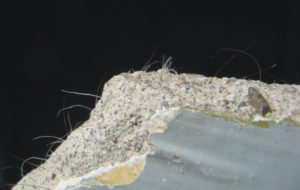
Asbestos was used extensively in construction materials from the 1940s through the late 1970s. Floor tiles, insulation, popcorn ceilings, pipe wrap, roof shingles, ductwork, and even plaster in millions of California buildings contain asbestos. When these materials are intact and undisturbed, they generally do not pose an immediate health risk. The danger begins the moment they are cut, drilled, sanded, broken, or demolished.
When asbestos-containing materials (ACMs) are disturbed, they release microscopic fibers into the air. These fibers are so small they are invisible to the naked eye, and once inhaled, they embed permanently in lung tissue. Over time, this exposure causes asbestosis, lung cancer, and mesothelioma — an aggressive cancer of the lining of the lungs or abdomen. Mesothelioma has a median survival time of 12 to 21 months after diagnosis.
California recognized these risks decades ago and enacted some of the strictest asbestos regulations in the nation, enforced by Cal/OSHA (Title 8), the EPA (NESHAP — National Emission Standards for Hazardous Air Pollutants), and local Air Quality Management Districts.
What the Law Requires Before Renovation or Demolition
Step 1: Asbestos Survey
Before any renovation, remodeling, or demolition project in a building constructed before 1980, California law requires a comprehensive asbestos survey performed by a CAC (Certified Asbestos Consultant) or a CSST (Certified Site Surveillance Technician). This is a legal prerequisite — not a suggestion.
The survey involves collecting samples of suspected materials and sending them to an accredited laboratory for analysis using Polarized Light Microscopy (PLM) or Transmission Electron Microscopy (TEM). Visual inspection alone cannot determine whether a material contains asbestos.
Critical point: California law requires that the entity performing the survey be independent from the entity performing the abatement. This prevents conflicts of interest and ensures unbiased results.
Step 2: Notification
If the survey confirms the presence of asbestos, the property owner or contractor must notify the local Air Pollution Control District (APCD) or Air Quality Management District (AQMD) before any work begins. Most districts require notification at least 10 working days in advance of the project start date.
Step 3: Abatement by a Licensed Contractor
Asbestos abatement must be performed by a contractor holding a valid California Class 22 (Asbestos Abatement) license and current DOSH (Division of Occupational Safety and Health) registration. The abatement must follow strict containment, removal, and disposal procedures mandated by Cal/OSHA Title 8, Section 1529.
These procedures include full containment of the work area with negative air pressure, HEPA-filtered air scrubbers, wet removal methods to minimize fiber release, proper bagging and labeling of all waste, transport by licensed hazardous waste haulers, and disposal at approved facilities.
Step 4: Clearance Testing
After abatement is complete, a separate certified inspector performs clearance air monitoring to confirm that airborne fiber levels meet safety standards before the area can be reoccupied or construction can proceed.
Common Materials That Contain Asbestos
Property owners are often surprised by where asbestos hides. Common asbestos-containing materials in California buildings include vinyl floor tiles and the black mastic adhesive beneath them, popcorn (acoustic) ceiling texture, pipe and duct insulation, roofing shingles and felt, cement siding (transite), vermiculite attic insulation, plaster and joint compound, fireproofing and spray-applied insulation, and window glazing and caulking.
What Happens If You Skip the Survey
The consequences of disturbing asbestos without proper procedures are severe. Workers and building occupants exposed to airborne asbestos fibers face a lifetime risk of mesothelioma, lung cancer, and asbestosis. Cal/OSHA fines for asbestos violations can exceed $70,000 per violation, and EPA NESHAP violations carry fines up to $99,681 per day. If asbestos is discovered during an unpermitted renovation, the project is immediately halted until proper abatement is completed — often adding weeks or months to the timeline and tens of thousands of dollars in cost. Property owners who fail to follow asbestos regulations can also be held personally liable for medical costs and damages to exposed individuals.
Recent Regulatory Changes: Electronic Waste Manifesting
As of 2025, California has implemented new requirements for electronic waste manifesting of asbestos disposal. All asbestos waste shipments must now be tracked electronically from the point of generation to the disposal facility. Contractors who are not current on this requirement risk violations even if the removal itself was performed correctly.
This is another reason why working with an experienced, licensed contractor is essential. Companies like CVE Corp stay current with regulatory changes and ensure every aspect of the project — from survey coordination through final waste disposal documentation — meets current requirements.
How to Choose an Asbestos Abatement Contractor in California
When evaluating contractors, verify the following: The contractor holds a current Class 22 (Asbestos Abatement) license with the California Contractors State License Board. They have current DOSH registration for asbestos-related work. They carry adequate liability insurance and workers’ compensation coverage specifically covering asbestos operations. They have documented experience with your type of project — residential, commercial, industrial, or government. The best contractors can handle the entire process from survey coordination through final clearance, giving you a single point of accountability.
Why California Property Owners Trust CVE Corp
CVE Corp (Central Valley Environmental) has been performing licensed asbestos abatement across California since 1996. We hold a Class 22 Asbestos Abatement License, Class A General Engineering and Class B General Building licenses, Hazardous Substance Removal Certification, and DOSH registrations for multiple California regions.
With offices in Rohnert Park, Tracy, Fresno, and San Diego, CVE provides statewide coverage with local expertise. We coordinate the entire process — from connecting property owners with licensed inspectors through final clearance testing — so you have a single point of contact throughout your project.
Every CVE employee is trained in strict accordance with OSHA guidelines and screened in excess of federal, state, and local regulations. We invest in ongoing training and the latest removal technologies to ensure every project is completed safely, efficiently, and in full regulatory compliance.
Frequently Asked Questions
Does every renovation require an asbestos survey?
In California, any renovation or demolition that will disturb building materials in a structure built before 1980 requires a survey. Even small projects — such as removing a single wall or replacing flooring — require testing if the materials could contain asbestos.
Can I test for asbestos myself?
Home test kits exist, but they are less reliable than professional testing and are not accepted for regulatory compliance purposes. California requires that surveys be performed by a Certified Asbestos Consultant (CAC) or Certified Site Surveillance Technician (CSST).
How much does asbestos abatement cost?
Costs vary based on the type of material, the area affected, accessibility, and disposal requirements. A small residential project may cost a few thousand dollars, while large commercial projects can be significantly more. CVE provides detailed, transparent estimates after evaluating the specific site conditions.
How long does abatement take?
Small residential projects may be completed in 1–3 days. Larger commercial or industrial projects can take several weeks. CVE provides detailed timelines during the initial assessment and offers 24-hour emergency response when needed.
Contact CVE Corp at (855) 912-6787 or visit cvecorp.com/contact for a free consultation on your next project.